
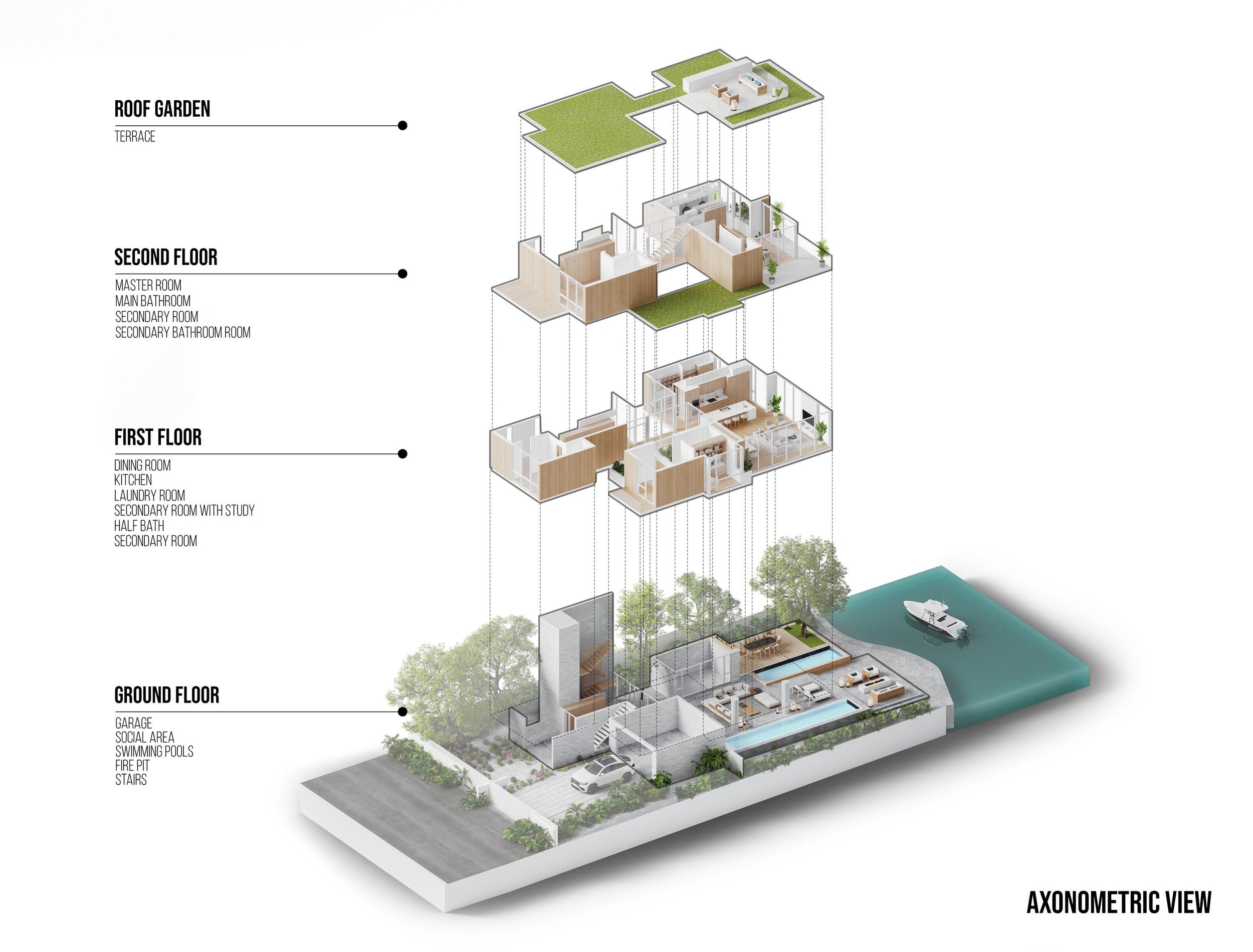
Waterfront sites are among the most coveted parcels on the Gulf Coast, and among the most poorly served by the architecture built on them. This is not a peripheral observation. It is something we encounter in conversation with clients, in the projects we are asked to follow, and in the pattern of development visible from the water along almost any stretch of coastal Sarasota or Siesta Key.
The problem is not ambition. Many waterfront homes are expensive, technically accomplished, and formally confident. The problem is that they misunderstand what a waterfront site is actually offering. In misunderstanding it, they waste it.
The Spectacle Problem
The most common failure mode in waterfront residential architecture is the treatment of the water view as a backdrop for a spectacle. The building is designed to be impressive from the street, to photograph well, to read as a status object. The water becomes a feature, a visual amenity to be framed through glass walls, rather than the primary condition that should be shaping the entire design.
This produces a particular kind of home that is recognizable throughout Florida: enormous street presence, often behind gates and setback vegetation, and a rear facade that is largely glass and exterior living space. The interior is organized around views rather than around living. The relationship to the water is visual and passive rather than spatial and experiential.
These homes are not failures in any simple sense. Clients often love them, at least initially. But they rarely produce the sense of inhabiting the landscape that the best waterfront architecture achieves. They sit next to the water. They do not belong to it.
What the Site Is Actually Asking For
A waterfront parcel on the Gulf Coast is not simply a piece of land with a good view. It is a site defined by light, water, wind, vegetation, ecological edge, and the particular quality of the atmosphere at the boundary between land and sea. Each of these conditions shifts throughout the day, throughout the seasons, and over the life of the building. Architecture that is only responding to the view is responding to the least interesting thing the site has to offer.
We approach waterfront sites with a set of questions that go beyond the view corridor. Where does the morning light enter from? What happens to the evening light on the water, and which interior spaces should be positioned to receive it? How do prevailing breezes move across the site, and can the building section amplify that movement rather than blocking it? Where is the vegetation, the existing mangroves, mature palms, and coastal scrub, and how does the building site itself in relation to that edge rather than erasing it?
These questions produce architecture that is oriented toward the site in a fuller sense. The building begins to feel like it grew from the conditions of the land rather than being placed on top of it.
The Spec Home Pattern
A significant share of waterfront residential development in Sarasota and on the keys follows a speculative pattern: a builder or investor acquires a waterfront parcel, builds to the maximum envelope permitted, optimizes for resale value and visual impact, and sells to a buyer who may or may not have any particular relationship to the site or the region.
The architecture that results from this process is predictably generic. The formal language is contemporary coastal: large roof overhangs, outdoor living areas, full-height glass, composite wood cladding. But it is applied as a style rather than developed in response to the site. The same home could be built on any waterfront parcel in Southwest Florida and would look equally at home nowhere in particular.
This is not an argument against contemporary coastal architecture. It is an argument for taking it seriously. The formal moves that define that language, the relationship between inside and outside, the management of light and air, the choice of materials that respond to climate and context, are powerful tools when they emerge from genuine site analysis. They become decoration when they are applied as a formula.
What We Try to Do Instead
The waterfront projects we are most satisfied with are the ones where the site has genuinely shaped the architecture. Where the section of the building came from the flood elevation and the view corridor simultaneously. Where the position of a pool was determined by the way the evening light moves across the water, not by a standard layout template. Where the exterior palette was arrived at by looking at the colors of the mangroves and the bleached wood of old dock structures rather than by selecting from a catalog of contemporary coastal finishes.
None of this produces architecture that announces itself loudly. In fact, the best waterfront homes we have built are quiet. They read confidently from the water but they do not compete with it. The site remains the dominant presence. The architecture creates the conditions for inhabiting it.
That is what a waterfront site deserves.