
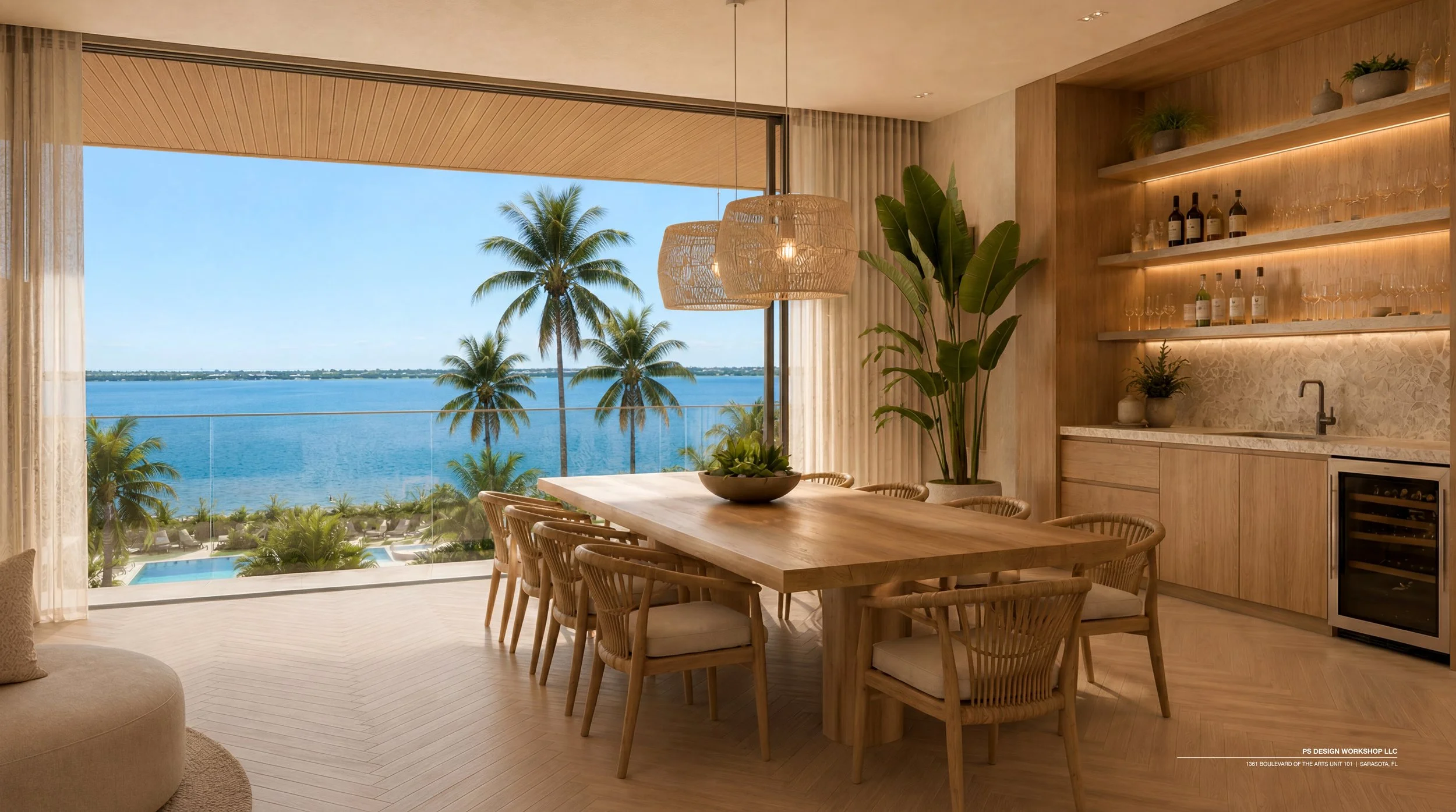
Architecture along Florida's Gulf Coast should not simply become a generic version of contemporary coastal modernism, nor should it fall into the repetitive language of white stucco boxes that have come to dominate so much residential architecture throughout various parts of Florida. At our office, we believe architecture should speak directly to its environment including the light, climate, landscape, and atmosphere that define a place. For us, designing in Sarasota means pursuing a regional vernacular that feels rooted in the Gulf Coast itself.
A Different Quality of Light
The Gulf Coast light is different than many other regions throughout Florida. Sarasota feels softer, hazier, and more atmospheric. While some coastal architecture throughout the state often leans toward sharp contrast, spectacle, and highly polished aesthetics, Sarasota has historically been quieter, more climate-responsive, and more human. Even the old Sarasota School modernism had restraint. It wasn't trying to scream. It was trying to dissolve into light, breeze, shadow, and landscape.
Materiality, Texture, and Tone
That idea continues to influence how we think about materiality, texture, and tone. While many contemporary coastal homes rely heavily on bright white stucco and sharp contrast, we are often drawn toward richer and more tactile exterior palettes and materials that feel weathered, layered, and connected to the environment around them. We believe warmth in architecture does not only come from color, but from texture, depth, shadow, and the way a material ages over time.
When we describe being drawn more toward driftwood, bleached tones, silvery woods, sun-washed textures, that actually feels deeply tied to place. It feels connected to dunes, mangroves, old dock wood, weathered cedar fencing, shells, sand, oxidized concrete, sea grape trunks. There is poetry in that palette that feels authentically Gulf Coast.
Belonging to the Landscape
Our interest in these softer and more weathered tones is not about nostalgia, nor is it about creating architecture that feels overly rustic or themed. Rather, it is about creating homes that feel as though they belong to their surroundings; homes shaped by salt air, filtered sunlight, coastal vegetation, and the slow bleaching effects of the Florida sun. We are interested in architecture that settles into the landscape rather than competing with it.
Restraint and Richness
At the same time, we recognize that restraint must be balanced with richness. A successful coastal palette cannot become flat or lifeless. It must create depth through shadow, layering, natural variation, and moments of warmth. This is why we often explore combinations of cooler, driftwood-inspired tones alongside warmer materials in protected spaces, soffits, entries, or interior transitions. The goal is not to establish a singular formula, but to create an emotional atmosphere specific to each project and site.
Architecture That Evolves
Every condition changes the perception of a material, including direct sun, shade, dusk, humidity, interior light, surrounding landscape. Coastal architecture is inherently dynamic, and we embrace that variability rather than resisting it. Materials should evolve throughout the day and continue to weather gracefully over time.
A Contemporary Gulf Coast Vernacular
Ultimately, we see Sarasota not as a place defined by excess, but as a place defined by atmosphere. We are interested in a contemporary Gulf Coast vernacular that feels calm, textural, enduring, and deeply connected to the character of this region. Architecture here should feel softened by light and air and less like an object placed on the landscape and more like something shaped by it.
PS Design Workshop Approach
With a deep understanding of Gulf Coast needs, PS Design Workshop offers expertise in creating homes that last. Our approach combines innovation with regional sensitivity.
PS Design Workshop is a modern residential architecture firm based in Sarasota, Florida. Learn more about our work →